Jonathan Demme’s 2004 update of the classic film The Manchurian Candidate presents an extraordinary woman whose once-heroic desire for the good of her country drives her to commit unspeakable atrocities. Believing the ends justify the means, and that the good of the many outweighs the good of the few, she turns from a hero to a monster who is the exact kind of enemy to the American way of life, liberty and the pursuit of happiness which she so earnestly opposes.
Senator Eleanor Shaw (Meryl Streep) sees herself as a hero, willing to do whatever it takes to make America a better place. She believes that America needs a strong leader who will guide the country and improve quality of life for all its citizens, that her idealistic son Raymond (Liev Schreiber) is just that man, and that the ends justify the means of getting him into that position. She aspires to be just like her father, John Prentiss, who she describes as a bold risk taker, not needing others’ approval but acting of his own accord, someone who “…never asked ‘Is this ok? Is this ok?’ He just did what needed to be done.”
Legendary actress Meryl Streep, who portrays Senator Shaw, agrees:
“[She is] bursting with intelligence, ambition, a clear idea of how to move the country forward, but she’s thwarted. . .I think she thinks she’s patriotic, deeply patriotic. She is someone who is a believer. It goes to the core of her being, and she is sure. There’s no neurosis about her. And that made her an interesting character for me because I play people who are sort of torn by contradictory emotions, and Ellie really isn’t. She’s a fundamentalist idealogue in the way that people maybe are forced to be in politics, because otherwise you’re perceived as weak.”
Eleanor Shaw is definitely not weak, nor could anyone think of her as such. She is strong and confident, unwilling to take no for an answer and unintimidated by even the most daunting of tasks--to get Raymond into the White House, first as the vice president, then as the Commander-in-Chief. She sees herself as a soldier on a crusade, her Holy Land is America and her God is John Prentiss. She wants the greatest good for her country and she thinks that is Raymond. But subconsciously, it’s not her son Raymond she wants in power, but her father. Through her mind-control, she has made Raymond as close an imitation as possible to her father, her hero, her God, and, by extension, herself .
However, there is another definition of hero. In the film Serenity, Zoe Washburn (Gina Torres) describes a hero as “someone who gets other people killed.” Eleanor Shaw doesn’t hesitate to kill. Working through mega-corporation Manchurian Global, she has an entire military platoon kidnapped, tortured, brainwashed and ultimately put under complete mind-control, to the point where each soldier would kill even his own squadmates if ordered to do so. She not only has military men killed, she orders the assassination of anyone--soldier, politician or ordinary citizen--who shows any indication that he or she has started to figure out what she is doing, which is maneuvering Raymond Shaw into position to become the new President of the United States.
She is convinced she’s doing the right thing for America, that her ends of the greater good justify her means of taking lives and breaking others, but she doesn’t truly know what she wants. She thinks she wants Raymond to lead America, but she doesn’t want the real Raymond with whose politics she disagrees, the man who wouldn’t even be in politics if he weren’t literally forced to do her commands, she wants her father to lead. John Prentiss is dead, so she does everything she can to turn her son into her father. When she looks at Raymond, she sees the man she has made him--an amalgam of her father and herself. Whatever is left of the person Raymond once was, she sees as an aberration, something to be kept under control and preferably erased permanently. She has taken a good man and replaced him with an abomination, and as clear as she can see the path to the White House, she has no understanding that the man she truly wants in the Oval Office is her father.
Eleanor’s relationship with Raymond is evidence of the depth to which she doesn’t understand her own motivations and desires. The movie heavily implies that she engages in non-consensual sexual relations with her son. He may not physically struggle or explicitly refuse her advances, but the brainwashing and mind-control she has inflicted on him has fundamentally compromised his self-awareness and free will to the point that he is unable to say no, and thus unable to give real consent.
She’s made her son into a monster. Due to the behaviour modifications that the Manchurian Global scientists performed on him, he has very little to no will of his own, which hardly makes him fit to lead the free world. She’s become a monster too, making her father into such an idol that she carries on an incestuous relationship with her brainwashed son who she has molded in his father’s image.
Eleanor Shaw might have benefited from talking to the antagonist, a man known only as the Operative (Chiwetel Eijofor), in the film Serenity. Like Senator Shaw, he believes the ends justify the means, but he understands that he, as the person carrying out the atrocities, is a monster, unfit to live in the world in whose name he commits his crimes. “Me and mine gotta lay down our lives so you can live in your perfect world?” asks a grieving man. The Operative replies: “I’m not going to live there. There’s no place for me there. I’m a monster. What I do is terrible but it must be done.” He understands that the monsters we make don’t go away once we get what we want, they stay around and ruin the future for which we strive so hard.
Works Cited
Streep, Meryl. Interviewed by Ethan Aames. “Interview: Meryl Streep on The Manchurian Candidate.” Cinecon.com Cinema Confidential. 28 August 2004. Web.
The Manchurian Candidate. Dir. Jonathan Demme. Paramount, 2004. DVD.
Serenity. Dir. Joss Whedon. Universal Pictures, 2005. DVD.
Monday, May 9, 2011

Want
For example, society and the media both encourage us to covet romantic love, devaluing family and platonic love and elevating romantic love higher than others by telling us that we should all have it, that without a romantic partner we are incomplete and alone. But most of us have something just as good--deep enduring love of family and/or friends, and as long as we have them, we are not alone. The enduring love of family or that best friend over the years is worth so much more than a high school boyfriend who gets forgotten a few years later.
We have an innate desire to be what society considers beautiful, whether the current standards prize symmetrical or asymmetrical features, long, short, straight, curly or wavy hair, sleekness or curves, spareness or bounty of body. But most of us already have what we need, and likely what someone else desires and considers beautiful--a reasonably strong healthy body with working appendages and functioning five senses.
In my own life, I was a rather isolated kid, reading countless books about ‘normal’ people, and naturally wanting what they had: three or more friends (and even more casual acquaintances) they saw multiple times a week, adult role models other than their parents, parents who cared if their kids were normal, and the delicious thrill of blowing off prom to go to a laid-back anti-prom party. I tried to be thankful for what I had: one or two friends I saw a couple times a year, a large family with whom I was friends, two sets of living grandparents, not to mention basic necessities of life such as enough food, clean water, and a warm house.
We should be content with what we have, but at the same time our drive to want more can lead to vast improvements in our own lives, in society and sometimes eventually the whole world. Womens’ dissatisfaction with the current laws in the early twentieth century resulted in their right to vote, own property and more. English colonists living in the thirteen colonies, dissatisfied with their king’s broken promises, wrote a certain historical charter and became Americans. Poor kids from uncaring families driven by a desire for better, put themselves through college, marry and are better mothers and fathers than their own parents were to them.
Thursday, April 28, 2011
Megamind and Metro Man: Destiny, Choice and a Really Great Costume
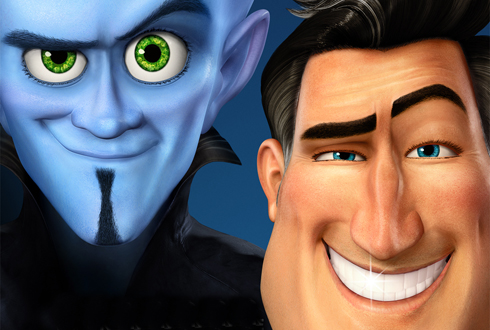

Megamind is obviously an alien. He’s about five feet tall, his body is slender as a toothpick but his hairless head is exaggeratedly large and shaped like an inverted teardrop. His skin is cerulean blue , his green eyes are large and round, and his chin is very pointy, sporting a carefully groomed and properly villainous black goatee. His costumes of choice are usually shiny and black, featuring steel studs, high bat-like collars and flowing capes, reminiscent of the borderline fetish-wear favored by innumerable super-villains in movie history. Megamind has no inhuman powers or pieces of seemingly-magical technology from his homeworld, only his brilliant mind, just like any human. The only thing he has from his planet is his friend the pint-sized Minion, a piscine creature who lives in a liquid-filled glass sphere. Minion loves Megamind unconditionally, and the two are inseparable, from Megamind’s school years through his rise to supervillainry and countless attempts to vanquish Metro Man and rule over Metro City.

Conversely, Metro Man looks perfectly human, bearing a remarkable resemblance to Superman crossed with Elvis Presley. However, unlike Megamind, his unearthly heritage imbues him with superpowers including invulnerability, super-strength and flying, which he uses to assist or defend others. He is at least six feet tall and heavily muscled with dark hair, blue eyes and clean-shaven square jaw, wearing elaborate fringed and sparkly costumes in whites, creams, golds and bronzes as he performs his heroic deeds. Though he is named ‘Protector of Metro City’ and the adoring citizens build a museum in his honor, the film depicts him as a man apart, without any real friends.
When Metro Man and Megamind are just days old, their parents send them away from their respective dying planets, and the two babies crash in Metro City on Earth. Megamind’s escape pod bounces right in the city’s prison, where he is subsequently raised by the community of super-smart criminals who teach the already-clever blue child everything they know. One could say he was destined to be a villain from the moment he landed in the prison yard., and naturally Megamind grows up with an aptitude for technologically-fueled mayhem, which he takes with him to his first school.
On the other hand, Metro Man’s pod glides right into the palatial home of an affluent couple. Though kind, they seem to relate to him as an adorable fancy toy who can fly and literally bounce off the walls without suffering injury, as opposed to a real person. His adoptive parents do realize that flight is an unusual trait in a youngster, so they send him to a school for gifted children, where he meets young Megamind. Metro Man soon begins his career as a hero, using his special abilities to protect his schoolmates from errant dodge balls, burning explosions of unexpected popcorn and other sundry accidents caused by the scientifically-inclined Megamind’s experiments. His motivations appear to be part showing off, part decent human behavior, both fueled by the desire to be liked and admired.
Similarly, Megamind begins his school days wanting friendship with the other children, but the devices he invents in attempts to imitate the feats that endeared Metro Man to the schoolchildren (such as popping popcorn with a laser gaze) never quite work the way he thinks they will, his inventions almost injuring the children. Subsequently he is excluded from normal childhood fun and games, and subjected to bullying. With Minion as his friend, sidekick and willing test subject, Megamind puts together increasingly effective anti-bullying devices and finally decides to stop trying to be liked and start indulging his penchant for trouble. He ends his school days with one last act of deliberate mischief, setting off a small explosion of blue paint powder in the schoolroom. The gleeful expression on his face as he rides away on the prison bus says it all; he has found something he loves to do, something he is good at doing, and something he’ll do for years to come.
As Megamind spends the next ten or so years hatching villainous plots (such as trying to render all of Metro City illiterate using a special ray gun), Metro Man feels obliged to be the one to step up and stop him. He is, after all a decent man whose gifts make him unusually suited to the task, and so whether or not Metro Man would have chosen a life of public service if Megamind didn’t insist upon playing the villain, the hero knows that as long as evil is around, good must rise up against it.
The two aliens seem at opposite ends of the spectrum of good and evil, as different as black and white, but a new picture begins to emerge once the movie viewer examines the pair, and realizes that the basic character elements and motivations that the superhero and supervillain have in common far outweigh their superficial differences.
Metro Man and Megamind are both orphans from alien planets, each with a liking for putting on a show in their costumes and actions, and each
character’s behavior stems from the same desire to be liked and accepted. They both have something from his lost homeworld: Megamind has Minion, and Metro Man has his otherworldly powers. The hero and the villain feel mostly or completely alone in the world, and though Metro Man enjoys helping people and Megamind relishes the elaborate dance of nefarious plotting, each feels forced into his role as hero or villain to a certain extent, and has questions about choosing one’s own path which he has been subconsciously mulling over his entire life. When school-aged Megamind comes to the erroneous conclusion that his only talent is causing chaos, he thinks that troublemaking is his destiny, so he embraces it.
Metro Man has been protecting Metro City ever since his and Megamind’s school days, so the hero thinks he has never had a choice.
By the movie’s end, each character has discovered that he does have a choice, and so he makes one. Metro Man realizes he has a choice just like any other person, and chooses to retire from being a superhero in favor of pursuing music, and Megamind has discovered that people judge him based on his actions, that he doesn’t love being evil so much as he loves putting on a show of good vs. evil--and chooses to become the new defender of Metro City. Ultimately we see that Megamind and Metro Man have more similarities than differences at the core, and the movie plays out the same ideas in the two characters. Each one forms half a yin-yang which when completed, gives a full picture of the movie’s themes of destiny, choice, finding one’s true calling--and the value of a really great costume.
Tuesday, April 19, 2011
Oops
Oh dear, I've been neglecting my blog. So much going on. Well, mostly going slightly crazy these past few weeks, what with the unexpected spring break (showing up for class and no one is there, what is that about? Homeschoolers don't get spring break as far as my experience goes. I certainly never did and most of my awareness of it is confined to a few movies and I don't trust movies) and being so crazy depressed I was unable to think. But that's over now (well, better anyway) and I hope it stays that way.
I went to a movie Saturday night with a couple of brothers and my best friend. Sucker Punch was pretty cool, and I don't regret seeing it, I did enjoy it, but it was the wrong movie to see at the time. A bit too bleak for me at this stage--I'd have enjoyed it more on DVD as a less immersive experience.
I went to a movie Saturday night with a couple of brothers and my best friend. Sucker Punch was pretty cool, and I don't regret seeing it, I did enjoy it, but it was the wrong movie to see at the time. A bit too bleak for me at this stage--I'd have enjoyed it more on DVD as a less immersive experience.
Wednesday, March 23, 2011
I wrote an entry. It was personal. I realized, too personal, concerning someone I know who just might be reading this blog.
I get depressed too. And I spend it mostly alone, partly so as not to inflict it on others who shouldn't have to.
Some people call me passive-aggressive. I say, there are some things that can't be said face to face without too much emotion clouding the issue.
I get depressed too. And I spend it mostly alone, partly so as not to inflict it on others who shouldn't have to.
Some people call me passive-aggressive. I say, there are some things that can't be said face to face without too much emotion clouding the issue.
Saturday, March 19, 2011
Jackpot!
There's a local auction where I live that goes on Friday nights, so every Friday afternoon when I come back from running errands, I stop in to see what's up for auction. There's a lot of yard-sale 'stuff', some vintage things, electronics, and usually several pieces of furniture, which is what I go to see. I'm in the market for a good desk with drawers and a shelf unit, and it's possible to get a really good price on decent furniture.
Usually I'm only interested in the furniture (everything else bores me) but yesterday I spied something I never thought I'd see--jewelry supplies, and lots of it. Boxes of tools or glues, zippered cases containing hanks of beads, packets of silver and coils of wire, two whole cases of seed beads (bead store Czech, not craft store Chinese), containers of sterling findings and components, and portable storage boxes containing all manner of faceted glass and Swarovski crystal.
I determined that I was going to buy at LEAST one case, even though I had never bought at a live auction before (and I was apprehensive, as the niggly details are really counterintuitive). But I went, and I bid, and I got a pair of $13 specialty stepped loop-forming pliers for only $5, two cases of sterling findings for $3 apiece (I was stunned that no one bid higher--I guess they didn't look very closely, or didn't know it was sterling) and another containing crystals for $3. Other beader women were there, outbidding me on the cases of seed beads. Every woman for herself, right? I'd say 'all's fair in love and beading' but that's not true, and also, it's a terrible cliche and overly cutesy for me.
The auctioneer moved on to a different table, leaving one case left unsold--the case containing glass, seed beads--and, I remembered, one case full of crystals, the one I wanted the most. Instead of just accepting that this wasn't for sale anymore, I asked when it would be auctioned--and the woman I asked happened to be the owner of the supplies, who worked at the auction and was willing to sell it outright.
Another lady was interested in buying it, and she made an offer. Even though it wasn't officially an auction anymore, I took a chance and made a higher offer (after making sure it was kosher to do so; even though it was in an auction house, I didn't want to step on toes by bidding when it wasn't officially an auction anymore). The first lady countered, and I countered again, winning the auction for $30 (lower than the amount I'd decided beforehand I was willing to pay). I knew that case had at least twelve containers of crystals, each valued at about $4, plus the other case of glass beads in a useful 4mm size (though the crystals were really what I wanted), so overall, I figured I was paying maybe 50% of the retail price.
Well, when I opened up the beads later to look at them again, I found out what I'd forgotten--that each case contained not twelve but twenty-four containers! Twenty-four of glass and seed beads, and twenty-four of crystal! Not only that, but also.... there was a third container I had forgotten, filled with the finest crystal beads in the world!
Yeah. Jackpot.
P.S. If you are enchanted with my tale of buying beads, and must see pictures, you can read my bead jewelry blog, The Beaded Passion.
Usually I'm only interested in the furniture (everything else bores me) but yesterday I spied something I never thought I'd see--jewelry supplies, and lots of it. Boxes of tools or glues, zippered cases containing hanks of beads, packets of silver and coils of wire, two whole cases of seed beads (bead store Czech, not craft store Chinese), containers of sterling findings and components, and portable storage boxes containing all manner of faceted glass and Swarovski crystal.
I determined that I was going to buy at LEAST one case, even though I had never bought at a live auction before (and I was apprehensive, as the niggly details are really counterintuitive). But I went, and I bid, and I got a pair of $13 specialty stepped loop-forming pliers for only $5, two cases of sterling findings for $3 apiece (I was stunned that no one bid higher--I guess they didn't look very closely, or didn't know it was sterling) and another containing crystals for $3. Other beader women were there, outbidding me on the cases of seed beads. Every woman for herself, right? I'd say 'all's fair in love and beading' but that's not true, and also, it's a terrible cliche and overly cutesy for me.
The auctioneer moved on to a different table, leaving one case left unsold--the case containing glass, seed beads--and, I remembered, one case full of crystals, the one I wanted the most. Instead of just accepting that this wasn't for sale anymore, I asked when it would be auctioned--and the woman I asked happened to be the owner of the supplies, who worked at the auction and was willing to sell it outright.
Another lady was interested in buying it, and she made an offer. Even though it wasn't officially an auction anymore, I took a chance and made a higher offer (after making sure it was kosher to do so; even though it was in an auction house, I didn't want to step on toes by bidding when it wasn't officially an auction anymore). The first lady countered, and I countered again, winning the auction for $30 (lower than the amount I'd decided beforehand I was willing to pay). I knew that case had at least twelve containers of crystals, each valued at about $4, plus the other case of glass beads in a useful 4mm size (though the crystals were really what I wanted), so overall, I figured I was paying maybe 50% of the retail price.
Well, when I opened up the beads later to look at them again, I found out what I'd forgotten--that each case contained not twelve but twenty-four containers! Twenty-four of glass and seed beads, and twenty-four of crystal! Not only that, but also.... there was a third container I had forgotten, filled with the finest crystal beads in the world!
Yeah. Jackpot.
P.S. If you are enchanted with my tale of buying beads, and must see pictures, you can read my bead jewelry blog, The Beaded Passion.
Wednesday, March 2, 2011
on route 522
Driving down route 522 at sixty miles an hour this morning. Riding, actually. I glance out of my left window from the backseat where I'm sitting and see a dead deer in the ditch. It must be dead, I reason, for no deer would ever voluntarily lie down next to a highway. Yet the deer is curled up in the ditch, as if she had lain down a few hours earlier, and never woken up. I feel a slight chill on my neck.
Subscribe to:
Posts (Atom)